The Afterlife in World Religions: Beliefs, Journeys, and Spiritual Visions

Updated: Apr 3

Across cultures and centuries, humanity has looked beyond the veil of death in search of meaning, continuity, and hope. The afterlife—whether imagined as Heaven, rebirth, ancestral realms, or cosmic renewal—shapes how communities understand morality, purpose, and the destiny of the soul.
This article explores afterlife beliefs in major world religions, tracing how different traditions describe what happens after death and how these visions guide the living. From resurrection and judgment to reincarnation, liberation, and ancestral continuity, these perspectives reveal the rich diversity of global spirituality and our enduring quest to understand life beyond life.
Use the menu below to explore afterlife beliefs across global traditions.
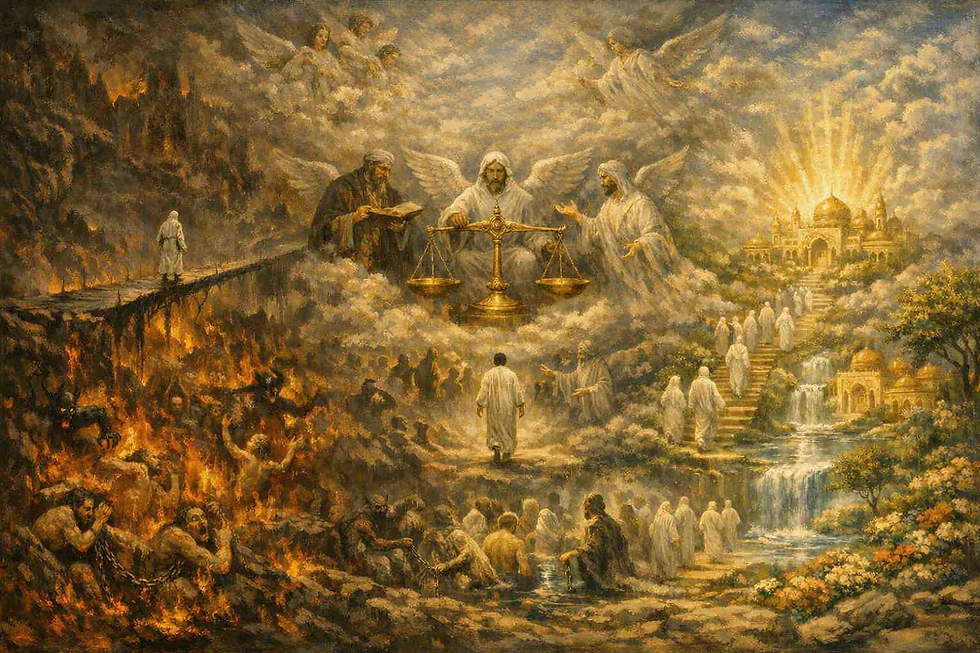
In Christianity, the afterlife is a central tenet of faith. Christians believe in the resurrection of the dead and eternal life, a promise rooted in the teachings of Jesus Christ and affirmed throughout the Bible. According to Christian doctrine, the soul is judged after death and sent to either Heaven or Hell based on one's faith and actions. Heaven is depicted as a place of eternal joy and communion with God, while Hell is a place of eternal separation from God and spiritual suffering. Some Christian denominations also teach the existence of Purgatory, a temporary state of purification for souls destined for Heaven.

The New Testament offers several passages describing the afterlife. One of the most cited is Paul’s assurance:
“By his power God raised the Lord from the dead, and he will raise us also.”
This verse reflects the Christian conviction that resurrection is not symbolic but a real, transformative event guided by God’s will.
The Book of Revelation also describes a renewed creation where “death shall be no more,” reinforcing the Christian hope in a restored world beyond suffering.

Islam teaches that the afterlife — Akhirah — is a central pillar of faith. Muslims believe that every soul will be resurrected on the Day of Judgment, when Allah will weigh each person’s deeds with perfect justice.
“We will set up scales of justice for the Day of Resurrection, so that no soul will be dealt with unjustly in the least.”
The righteous will be welcomed into Jannah, rewarded with eternal paradise, described in the Quran as a garden of peace, flowing rivers, beauty, and eternal closeness to Allah.
“God has promised men and women who believe gardens with streams of running water where they will abide for ever, and beautiful mansions in the Garden of Eden, and the blessings of God above all. That will be happiness supreme.”
(Ahmed Ali, Quran 9:72)
The wicked, those who turned away from righteousness face Jahannam (Hell), a realm of punishment or purification depending on one’s deeds and the mercy of Allah. It is portrayed as a place of torment and separation from divine presence — a stark contrast to the serenity of Jannah.
The Quran and Hadith provide detailed descriptions of the afterlife, emphasizing the importance of living a righteous life. The Quran vividly describes the afterlife. One well‑known verse states:
“Every soul shall taste death, and you will only be given your full reward on the Day of Resurrection.”
This passage emphasizes accountability and the eternal consequences of earthly choices.
The Hadith literature expands on these themes, describing the questioning in the grave, the weighing of deeds on the Mizan, the crossing of the Sirat (the bridge over Hell), and the boundless mercy of Allah that ultimately determines one’s fate.
Judaism embraces a wide and nuanced spectrum of beliefs about the afterlife, shaped by centuries of interpretation varying among diverse Jewish traditions. The Hebrew Bible (Tanakh) offers only brief hints about life after death, focusing primarily on righteous living in the present.
However, later Jewish writings — including the Talmud, Midrash, and Kabbalistic texts — expand on these early hints, introducing more detailed teachings about the resurrection of the dead, the World to Come (Olam Ha‑Ba), and the Messianic Age.
Across Jewish traditions, these themes are understood in different ways: some emphasize the resurrection of the dead and the future Messianic Age in which justice and peace are restored. While others emphasize the immortality of the soul, its purification, its journey to the World to Come (Olam Ha-Ba), and its gradual ascent toward closeness with God in Olam Ha‑Ba.
A foundational passage appears in the Book of Daniel:
“Multitudes who sleep in the dust of the earth will awake: some to everlasting life, others to shame and everlasting contempt.”
This is one of the clearest biblical references to resurrection and divine judgment, and it becomes a cornerstone for later Jewish thought.
Some Jewish traditions also describe Gehinnom, a realm of purification where the soul undergoes spiritual cleansing before entering Olam Ha‑Ba. Souls may pass through Gehinnom for up to twelve months to be cleansed of spiritual impurities. Unlike eternal damnation, Gehinnom is often portrayed as a fiery or shadowy realm, not one of hopeless torment, but a temporary stage of reflection, refinement, and divine mercy.
Kabbalistic teachings deepen this further, describing the soul’s refinement and its journey through layered realms, each preparing it for ultimate closeness with God and its return to divine light.
Ancient texts also mention Sheol, a neutral and shadowy realm of the dead. While less emphasized in modern Jewish thought, Sheol remains part of the historical framework, reflecting early conceptions of the soul’s resting place before resurrection or ascent.
Across Jewish thought, the afterlife is often understood not as a distant realm but as a continuation of one’s relationship with God — shaped by the moral and spiritual life one cultivates in this world, and the soul’s journey continues in the presence of the Divine.
Despite these variations, a shared thread runs through Jewish thought: the afterlife is not a distant, abstract realm, but a continuation of one’s relationship with God.

Hinduism offers a complex and multifaceted view of the afterlife, rooted in the concepts of karma, dharma, and reincarnation. Hindus believe that the soul (atman) is eternal and moves through the cycle of birth, death, and rebirth (samsara). The nature of one's next life is determined by karma, the accumulated moral weight of one's actions. The ultimate goal is to achieve moksha, liberation from the cycle of samsara, and union with the divine Brahman, the supreme reality. Various paths, including devotion (bhakti), knowledge (jnana), and righteous living (dharma), can lead to moksha.
Sacred texts such as the Bhagavad Gita and the Upanishads describe the soul’s journey after death with remarkable clarity. In the Gita, Krishna teaches:
“Just as a person discards worn‑out garments and puts on new ones, so the soul discards worn bodies and enters new ones.”
This verse encapsulates the Hindu understanding of reincarnation as a natural, continuous process.
Hindu traditions also speak of Yama, the god of death, who oversees the transition of souls and the unfolding of karmic consequences. While not a figure of fear, Yama represents cosmic order and the moral structure of the universe.

Buddhism shares the concept of samsara with Hinduism but offers a distinct perspective on the afterlife. Rather than an eternal soul, Buddhism believe in the cycle of rebirth, teaching the continuity of consciousness shaped by ones actions (karma) determine the nature of future existences. After death, beings are reborn into one of several realms, depending on their actions, intentions, and mental states.
The ultimate goal is to attain Nirvana, a state of liberation from suffering and the release from the cycle of rebirth. The Dhammapada, one of the most widely read Buddhist texts, states:
“Neither in the sky, nor in the midst of the sea, nor by entering a mountain cave — nowhere on earth is there a place where one can escape the results of one’s evil deeds.”
This line reflects the Buddhist emphasis on ethical conduct and the enduring impact of karma.
Different Buddhist traditions have varying interpretations of the afterlife, with some Buddhist traditions, particularly Tibetan Buddhism, emphasizing the existence of an intermediate state known as the bardo, where consciousness transitions between death and rebirth. This period is seen as both a moment of clarity and a profound opportunity for liberation.
Meditation, ethical conduct, and wisdom are key practices for achieving enlightenment.

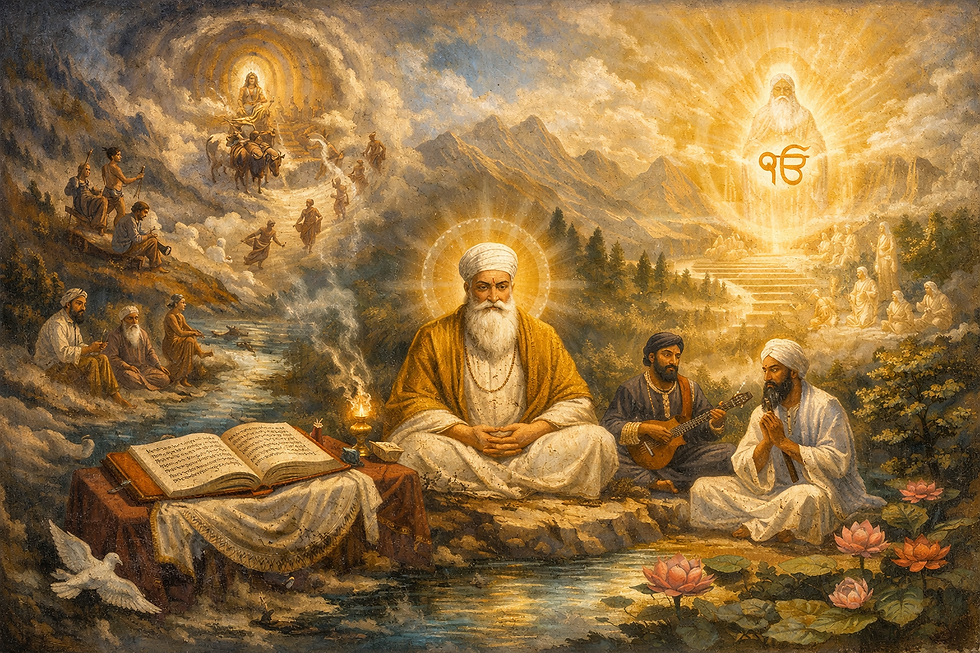
Sikhism includes the belief in reincarnation and karma, teaching that the soul goes through cycles of births and deaths, shaped by karma. The ultimate goal is to merge with Waheguru (God), the Divine and achieve liberation (mukti) from the cycle of rebirth. This is achieved not through asceticism but through devotion, righteous living, as well as the remembrance and meditation on God's name (Naam Simran).
The Guru Granth Sahib, Sikhism’s central scripture, speaks often of the soul’s journey. One verse teaches:
“By the karma of past actions, the robe of this body is obtained; by His Grace, the Gate of Liberation is found.”
This passage highlights the balance between personal responsibility and divine grace.
Unlike many traditions, Sikhism does not emphasize detailed descriptions of heaven or hell. Instead, it focuses on spiritual alignment with truth, compassion, and humility — qualities that naturally lead the soul toward liberation.
Taoism views the afterlife not as a fixed destination but as a continuation of the natural cycle of transformation and renewal. Life and death are seen as complementary movements within the Tao, the underlying harmony of the universe. Rather than focusing on judgment or reward, Taoist teachings emphasize alignment with the Way, cultivating balance, virtue, and inner stillness.
The Tao Te Ching, attributed to Laozi, speaks of death with quiet acceptance. One passage teaches:
“It is said that he who knows well how to live meets no tigers or wild buffaloes on his road, and comes out from the battle-ground untouched by the weapons of war. For, in him, a buffalo would find no butt for his horns, a tiger nothing to lay his claws upon, and a weapon of war no place to admit its point. How is this? Because there is no room for Death in him.”
This verse suggests that those who live in harmony with the Tao transcend the fear of death, moving effortlessly with the rhythms of existence.
Some Taoist traditions describe the existence of various spiritual realms, immortals, and celestial bureaucracies, while others focus on the dissolution of the self into the greater cosmic flow. Across these interpretations, the afterlife is understood as a natural unfolding rather than a final judgment. The soul's journey after death is influenced by one's actions and alignment with the Tao (the Way).

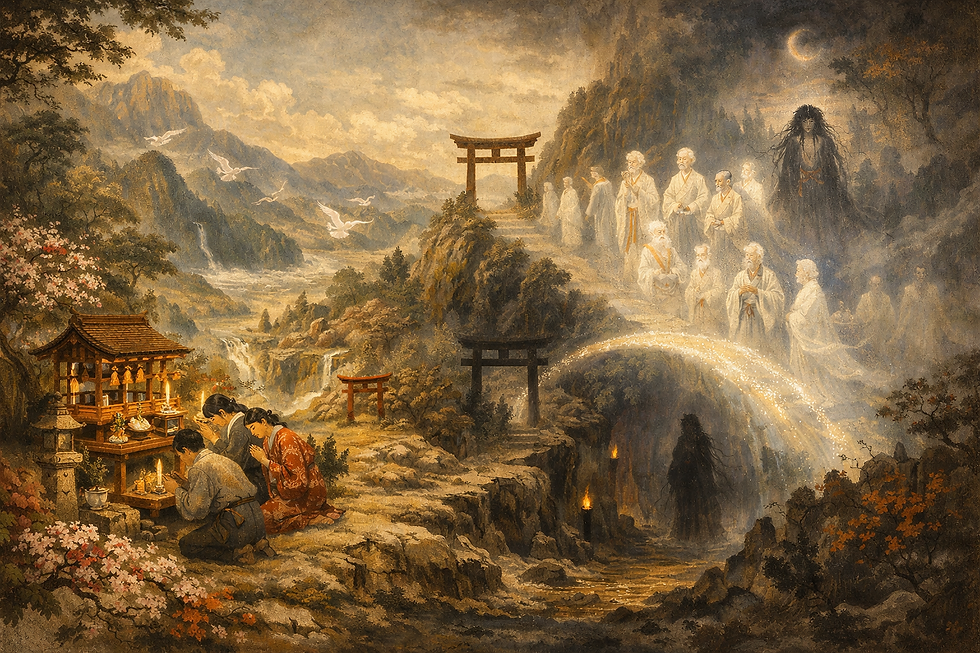
Shinto, the indigenous spirituality of Japan, centers on the presence and importance of kami — divine spirits found in nature, ancestors, and sacred places. After death, individuals are believed to become ancestral kami and join the ancestral spirits, continuing to influence and protect their descendants. The afterlife is therefore not distant or abstract but intimately connected to family, land, and community.
Classical Shinto texts such as the Kojiki describe early Japanese views of death. One well‑known story recounts the descent of Izanami, the primordial mother goddess, into Yomi, the shadowy land of the dead. Her transformation into a death‑associated kami reflects the Shinto understanding that death is both a natural transition and a source of spiritual power.
A paraphrased line from the Kojiki describes the boundary between worlds:
“Beyond the slope lies Yomi, where the living may not linger.”
This imagery highlights the separation between the physical world and the realm of ancestral spirits, yet rituals and offerings maintain a bridge between them.
In everyday Shinto practice, the living honor and worship their ancestors through rituals and offerings, such as household altars (kamidana) and seasonal festivals, ensure that the living remain in relationship with those who have passed on, and maintaining a connection between the physical and spiritual worlds.
The ancient Egyptians developed one of the most intricate and symbolically rich visions of the afterlife in human history. They believed in an eternal life after death, that death marked the beginning of a perilous yet transformative journey through the Duat, the underworld, where the soul encounters trials, guardians, and divine judgment. Central to this process was the weighing of the heart of the deceased against the feather of Ma'at, the goddess of truth, justice, and cosmic order. If the heart was pure and lighter than the feather, the soul entered the Field of Reeds, a paradise mirroring the beauty of earthly life. If heavier, it was devoured by Ammit, a fearsome creature, ending its existence.
Much of what we know about Egyptian afterlife beliefs comes from the Book of the Dead, a collection of spells and guidance intended to help the deceased navigate the Duat. One passage declares:
“My heart is mine, and it shall not betray me in the presence of the gods.”
This reflects the Egyptian conviction that moral integrity was the key to eternal life.
The god Osiris, ruler of the underworld and symbol of resurrection, presided over the final judgment. His presence ensured that death was not an end but a passage into renewed existence.

Zoroastrianism, one of the world's oldest monotheistic religions, presents a vivid and morally charged vision of the afterlife. Zoroastrianism teaches that after death, each soul approaches the Chinvat Bridge, where its deeds are weighed. The righteous soul is guided by divine beings to the House of Song (paradise), a realm of light and harmony.
While the wicked soul falls into the House of Lies (hell), a place of spiritual darkness. At the end of time, the final judgement will occur, where all souls will be resurrected and the world renewed in a final act of cosmic restoration.
These teachings are preserved in the Avesta, the sacred scriptures of Zoroastrianism. A passage from the Yasna proclaims:
“May the soul of the righteous cross the Chinvat Bridge with ease.”
This line captures the Zoroastrian emphasis on truth, righteousness, and the moral consequences of human action.
Divine figures such as Ahura Mazda, the supreme creator, and Mithra, associated with justice and the weighing of souls, play central roles in guiding and judging the departed.

In ancient Celtic traditions, the afterlife was understood as a continuation of the soul’s journey rather than a final destination. The Celts believed in the immortality of the soul, and its passage through multiple lifetimes, a cycle shaped by spiritual growth and cosmic balance. Death was seen not as an ending but as a transition into the Otherworld, a realm of beauty, mystery, and ancestral presence. In later Welsh tales, this Otherworld is called Annwn, often portrayed as a place where the boundary between worlds grows thin and the ordinary flow of time moves differently.
In the Welsh Mabinogion, Annwn appears as a parallel Otherworld—a place of beauty, power, and strangeness that intersects with the human world. Its most vivid portrayal occurs in Pwyll, Prince of Dyfed, where Pwyll accidentally crosses into Annwn and exchanges places with Arawn, its ruler. He spends a year in this Otherworld, experiencing a realm where ordinary rules seem suspended and encounters carry a sense of enchantment and liminality. Annwn is depicted as a place reached through sudden crossings, mists, or chance encounters, suggesting a world where the boundary between realms is thin and permeable.
Classical writers such as Julius Caesar noted that the ancient Druids, the priestly class in Celtic societies, believed in the immortality of the soul and its reincarnation. They taught the transmigration of souls, that the soul would pass from one body to another after death, continuing its journey through multiple lifetimes. This cycle of life, death, and rebirth was a fundamental aspect of Celtic spirituality, cultivating courage in battle and serenity in the face of death. While the Celts left no sacred texts, later mythological cycles describe the Otherworld as a place ruled by figures such as Arawn, lord of Annwn, who embodies the liminal space between life and death.
"They wish to inculcate this as one of their leading tenets, that souls do not become extinct, but pass after death from one body to another..."
(Julius Caesar, Gallic Wars 6.14 on Druids and immortality of the soul)
This imagery reflects the Celtic understanding of the afterlife as a place of renewal, wisdom, and spiritual continuity.

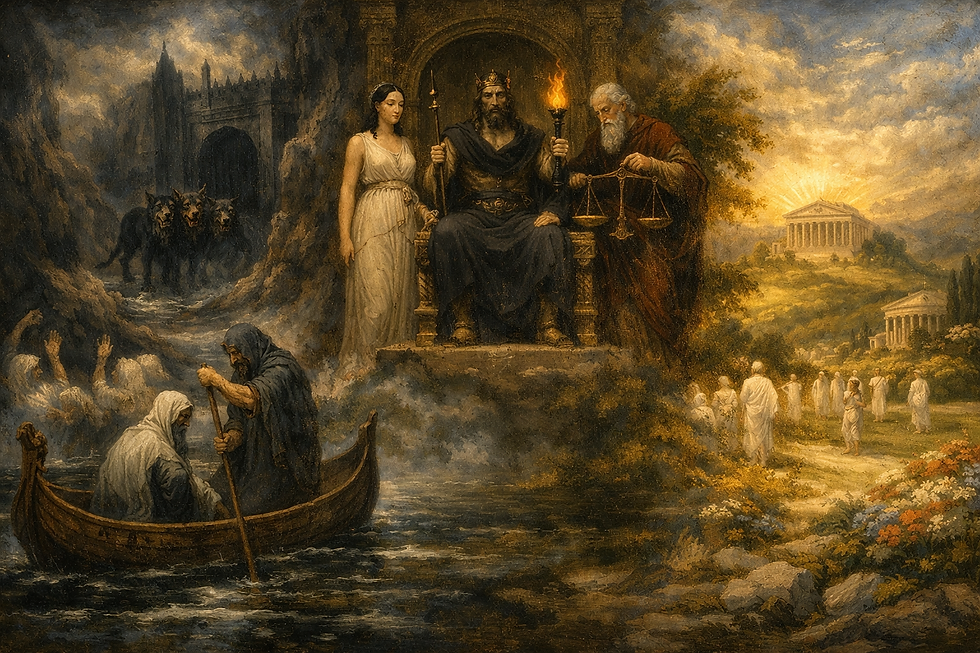
The ancient Greeks developed a rich and varied understanding of the afterlife, shaped by mythology, philosophy, and mystery traditions. While popular belief centered on Hades and the journey of the soul across the river Styx, Greek philosophers offered more introspective interpretations.
Philosophers like Pythagoras, Socrates, and Plato explored the concept of metempsychosis, or the transmigration of souls. In Plato’s Phaedo, Socrates describes death as a release of the soul from the body, allowing it to seek truth more fully. A well‑known passage states:
“The soul is immortal and imperishable.”
(Paraphrased from Phaedo 106b)
This line reflects the philosophical conviction that the soul continues its journey beyond physical death.
Greek myth also portrays the afterlife as a landscape of varied destinies — from the blissful Elysian Fields to the shadowy plains of Hades. The soul’s journey was often depicted as crossing a river guided by Charon, symbolizing the transition between worlds.
Within certain philosophical and mystery traditions, the soul was believed to be immortal and destined for repeated rebirths. After death, it would pass into a new body, continuing this cycle until it achieved purification and enlightenment. The river crossing became a powerful symbol of transition, guided by a boatman who ferried the soul across the threshold between one life and the next, marking its ongoing journey toward wisdom and liberation as the cycle of rebirth continued until the soul achieved eventual purification and enlightenment.
Indigenous religions around the world hold unique, profoundly diverse and place‑rooted understandings of the afterlife. While each community has its own stories, rituals, and cosmologies, many share a common thread: the belief that the soul remains connected to the land, the ancestors, and the living community long after death. Rather than imagining the afterlife as a distant realm, Indigenous traditions often describe it as a continuation of relationship — with country, kin, and spirit beings.
In many cultures, the afterlife is understood through oral traditions, passed down through stories, songs, and ceremonial practices. These teachings describe the soul’s journey into ancestral realms, where it joins those who came before and watches over those who remain. Such teachings emphasise that the boundary between the living and the ancestral world is permeable, maintained through ritual, memory, and respect.
Across continents — from the First Nations of North America, to the Māori of Aotearoa (New Zealand), to the Sámi of northern Europe — the afterlife is often tied to sacred landscapes, totemic identities, and ancestral guardians. These realms are not abstract heavens or hells but living extensions of the world itself, woven into mountains, rivers, forests, and stars.
Because many Indigenous traditions are oral and community‑held, they do not rely on written sacred texts. Instead, knowledge is preserved through elders, ceremonies, and cultural custodians. This ensures that teachings about the afterlife remain living, relational, and deeply embedded in cultural identity.
Across many Indigenous cultures, ancestral spirits are revered and honored through rituals, totems, and sacred landscapes, and the afterlife is understood as a continuation of the soul’s journey, where it remains intimately connected to the living community and the natural world.
This overview recognises only broad themes shared across many Indigenous cultures; each community holds its own distinct teachings, protocols, and ancestral relationships that deserve deeper exploration in future expansions of this work.

The Afterlife as a Shared Human Journey
The concept of the afterlife is a profound and deeply personal aspect of religious belief. While different religions offer unique perspectives on what happens after death, they all provide a framework for understanding the mysteries of existence and the hope for a continued journey beyond this life. By exploring these diverse beliefs, we gain a greater appreciation for the rich tapestry of human spirituality and the enduring quest for meaning and purpose.
Explore Global Faiths
Discover belief systems, traditions, and spiritual histories from around the world.
Explore Divine Figures
Meet the gods, heroes, spirits, and mythic beings that shaped cultures and stories across history.
Explore the Library
Continue your journey through the writings and studies that shaped cultures and stories across history.
Living Archive Contributors
This article is part of the Living Archive, where manuscripts evolve over time through research, refinement, and the work of multiple contributors.
28 January 2025 — Initial draft by Alex Ingram.
23 March 2026 — Expanded and refined by Harold Caldwell.
Future contributors will be acknowledged as the Archive continues to grow.


Comments