Exploring Dharmic Religions: From Vedic Roots to Modern Practices

Updated: Apr 3

Dharmic religions, originating in the Indian subcontinent, form a vibrant tapestry of spiritual traditions shaped by the concept of dharma: righteous living, ethical action, and the pursuit of harmony within oneself and the world. This family of traditions includes the Vedic religion, Hinduism, Buddhism, Jainism, and Sikhism. Though each developed its own distinct philosophy, they share deep cultural roots and a long history of dialogue, evolution, and reinterpretation. This article explores the origins and key aspects of these faiths, highlighting both their common heritage and their distinct philosophies.
The Vedic Religion
Origins
The Vedic religion, also known as Vedism, flourished between 1500-500 BCE and is widely regarded as the earliest layer of what would later become Hinduism. Practiced by the early Indo‑Aryan communities of ancient India—who composed the Vedas, the oldest surviving scriptures of the region—it centered on ritual, cosmic order, and the sacred authority of these texts.
Key Texts and Beliefs
The Four Vedas—Rigveda, Samaveda, Yajurveda, and Atharvaveda—form the core of Vedic thought. This tradition centered around the worship of various deities, rituals, and sacrifices, with a focus on maintaining cosmic order (rta) and seeking the favor of the gods through yajnas (sacrificial rituals) conducted by priests. Deities such as Agni (fire), Indra (storm and war), Varuna (cosmic order), and Soma (ritual drink) played central roles in sustaining harmony between humans, nature, and the divine.

Hinduism
Origins
Hinduism gradually emerged from the Vedic tradition, expanding over centuries and incorporating a diverse array of philosophies, rituals, and cultural practices. The Upanishadic period (800-200 BCE) marked a significant transition, introducing deeper philosophical reflections on the nature of the self, ultimate reality, and liberation.
Key Teachings and Practices
Hinduism emphasizes concepts such as dharma (duty/righteousness), karma (the moral law of cause and effect), samsara (the cycle of rebirth), and moksha (liberation from the cycle of rebirth). Its sacred literature is vast; major texts include the Vedas, Upanishads, Bhagavad Gita, Ramayana, and Mahabharata. Hindu practices vary widely — ritual worship, meditation, pilgrimage, festivals, and devotion to a multitude of deities such as Vishnu, Shiva, and Devi.

Buddhism
Origins
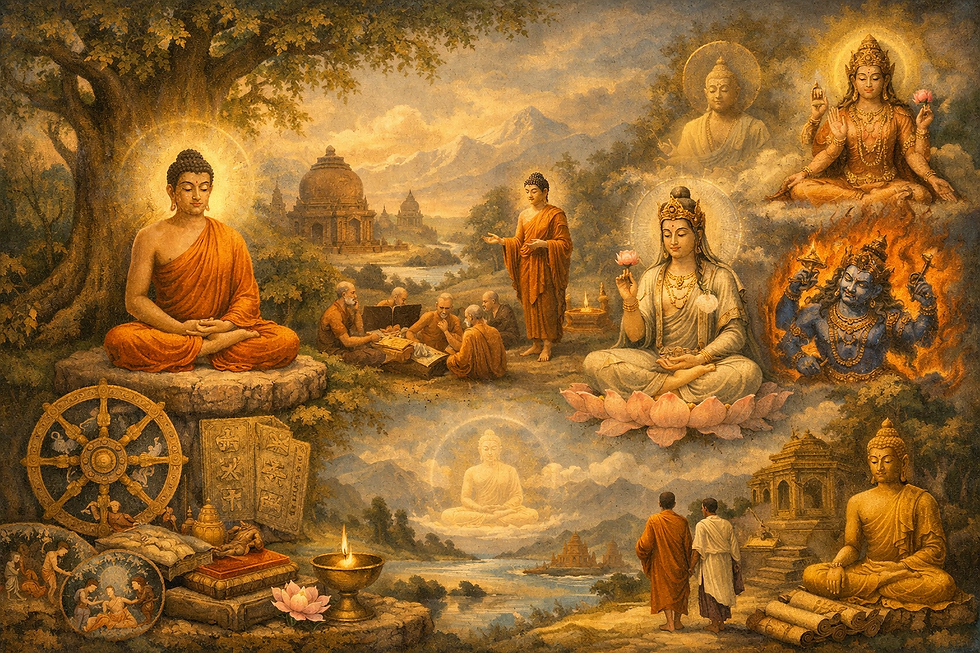
Buddhism was founded by Siddhartha Gautama, known as the Buddha, in the 6th century BCE. It emerged as a reform movement within the broader Vedic tradition, seeking a direct path to awakening by understanding the nature of suffering and the means to transcend it — a journey that ultimately leads to enlightenment and liberation from suffering.
Key Teachings and Practices
Buddhism centers on the Four Noble Truths and the Eightfold Path, which outline the nature of suffering and the way to overcome it, guiding practitioners toward ethical living, mental clarity, and liberation (nirvana). Key concepts such as karma, samsara, and nirvana (liberation) remain central, though interpreted differently from Hinduism. Over time, Buddhism developed into major branches—Theravada, Mahayana, and Vajrayana—each offering unique interpretations, practices and philosophical insights.
Jainism
Origins
Jainism arose alongside Buddhism in the 6th century BCE as part of the Shramana movement, which challenged the Vedic orthodoxy and ritual authority. It was founded by Mahavira, the 24th Tirthankara (spiritual teacher) and shaped by his teachings, which articulated a path of radical non‑violence and self‑discipline.
Key Teachings and Practices
At the heart of Jainism is ahimsa—non‑violence in thought, word, and action. Jain ethics also emphasize truthfulness, non‑stealing, celibacy, and non‑possessiveness. The religion teaches that souls undergo cycles of birth and rebirth and aims to achieve liberation (moksha) through strict ethical conduct, meditation, and ascetic practice. The tradition is divided into two major sects: Digambara and Svetambara.

Sikhism
Origins
Sikhism emerged in the 15th century CE, founded by Guru Nanak and shaped by his teachings, which envisioned a path rooted in devotion, equality, and social justice. Arising in the Punjab region, Sikhism drew from both Hindu and Islamic contexts while establishing a distinct spiritual identity, expressing a unique path of devotion and social justice.
Key Teachings and Practices
Sikhism emphasizes the devotion to one God, honest living, the teachings of the ten Sikh Gurus, the importance of community service (seva), and equality. Key texts include the Guru Granth Sahib, the living scripture, which is the central scripture of Sikhism, it preserves the teachings of the Sikh Gurus. Practices include daily prayers, meditation on the divine name (Naam Japna), and communal kitchens (Langar) embody Sikh values of humility, equality, and compassion.

The Enduring Legacy of Dharmic Religions
The Dharmic religions, with their rich histories and profound teachings, offer diverse paths to spiritual growth and ethical living. Despite their differences, they share ancient roots in the Vedic tradition and emphasize the importance of dharma in shaping individual and societal well-being. Their enduring legacy continues to influence millions of lives around the world, enriching the spiritual and cultural heritage of humanity.
Explore Global Faiths
Discover belief systems, traditions, and spiritual histories from around the world.
Explore Divine Figures
Meet the gods, heroes, spirits, and mythic beings that shaped cultures and stories across history.
Explore the Library
Continue your journey through the writings and studies that shaped cultures and stories across history.
Further Reading
Explore foundational texts and studies that illuminate the evolution of faiths, philosophies, and cultural traditions across India and beyond.
Sacred Texts and Commentaries
These scriptures and commentaries form the spiritual and philosophical backbone of the Dharmic world.
The Four Vedas — Hymns of cosmic order, devotion, and ritual wisdom
The Upanishads — Philosophical dialogues on the self and ultimate reality
The Bhagavad Gita — Reflections on duty, devotion, and liberation
The Dhammapada — Verses of the Buddha’s ethical and spiritual teachings
The Āgamas and Tattvārtha Sūtra — Jain scriptures on non‑violence and liberation
Guru Granth Sahib — The living scripture of Sikhism, celebrating divine unity and equality
Historical and Cultural Studies
These works trace the historical, artistic, and philosophical development of India’s spiritual landscape.
A History of Indian Philosophy by Surendranath Dasgupta
The Wonder That Was India by A.L. Basham
The Religions of India by Edward Washburn Hopkins
Indian Art and Spirituality by Stella Kramrisch
The Discovery of India by Jawaharlal Nehru
Modern Reflections
Modern voices continue the dialogue between ancient wisdom and contemporary life, offering reflections on ethics, devotion, and non‑violence.
The Essential Gandhi edited by Louis Fischer
The Heart of the Buddha’s Teaching by Thich Nhat Hanh
The Living Gita by Swami Satchidananda
Non‑Violence: The Transforming Power by Mahatma Gandhi
Follow the button below to enter the library.


Comments